
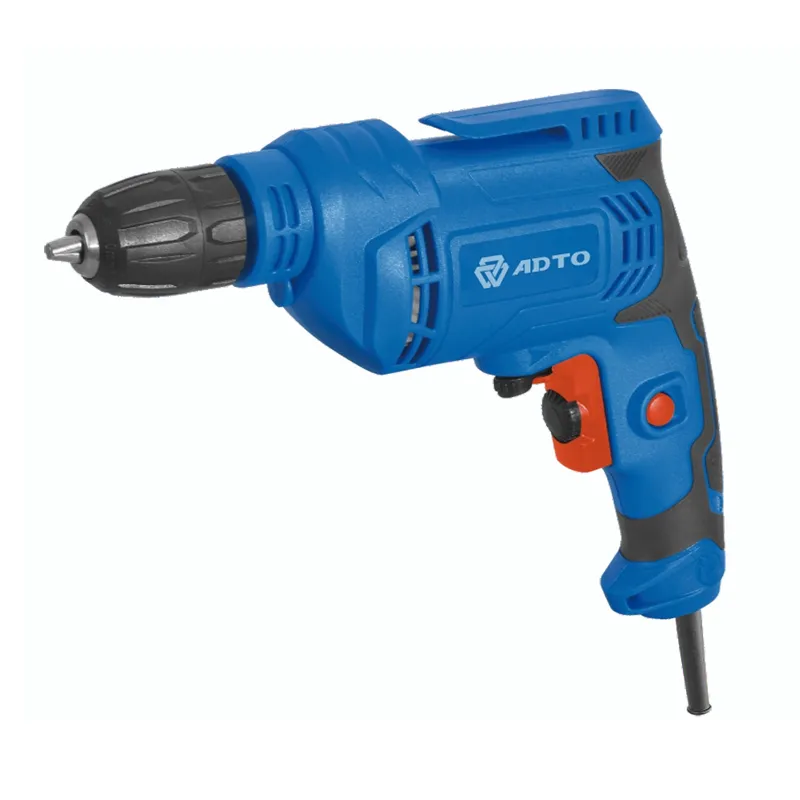


6110A

Product Application Scope
| Primary Work Objects | Typical Work Scenarios |
| Wood Drilling: | Easily handles thick wood, hardwoods, and engineered wood using woodworking drill bits |
| Metal Drilling: | Efficiently drills holes in steel, iron, aluminum profiles, and metal sheets using appropriate drill bits |
| Masonry and Concrete: | With impact function, it can be used for drilling in walls, bricks, and concrete |
| Plastics and Composites: | Provides stable speed control to prevent plastic melting or cracking |
| Screw Driving and Assembly: | Suitable for furniture assembly, cabinet installation, and mechanical assembly tasks requiring consistent torque |
Advantage/Benefits
| Advantage: | Benefit(Your Gain): |
| Sustained high power, no battery depletion issues | Provides reliable, uninterrupted power, ideal for workshops and long-term projects |
| No charging or battery replacement required | Typically offers higher torque and speed for demanding materials |
| Typically higher power, suitable for heavy-duty tasks | Eliminates downtime due to battery charging or failure |
| Lower long-term operating costs | More economical in the long run, no battery maintenance or replacement needed |
| Stable torque and speed under continuous use | Suitable for stationary work where portability is not a primary requirement |
How to use
Select the appropriate drill bit or driver bit based on the material.
Securely insert the drill bit into the chuck and tighten it.
Connect the power drill to a power outlet, ensuring the power cord is safely positioned.
Select the correct rotation direction (forward/reverse), and adjust the torque/speed if applicable.
Grip the power drill firmly, align it with the workpiece, and begin drilling or driving screws at a low speed.
After use, unplug the power cord, clean the drill bit, and store it in a dry place.
Regularly check the power cord and plug for wear or damage.